
On this page
An Avios booking is worth it when it saves you more cash per Avios than an Avios is worth to you. Work it out like this:
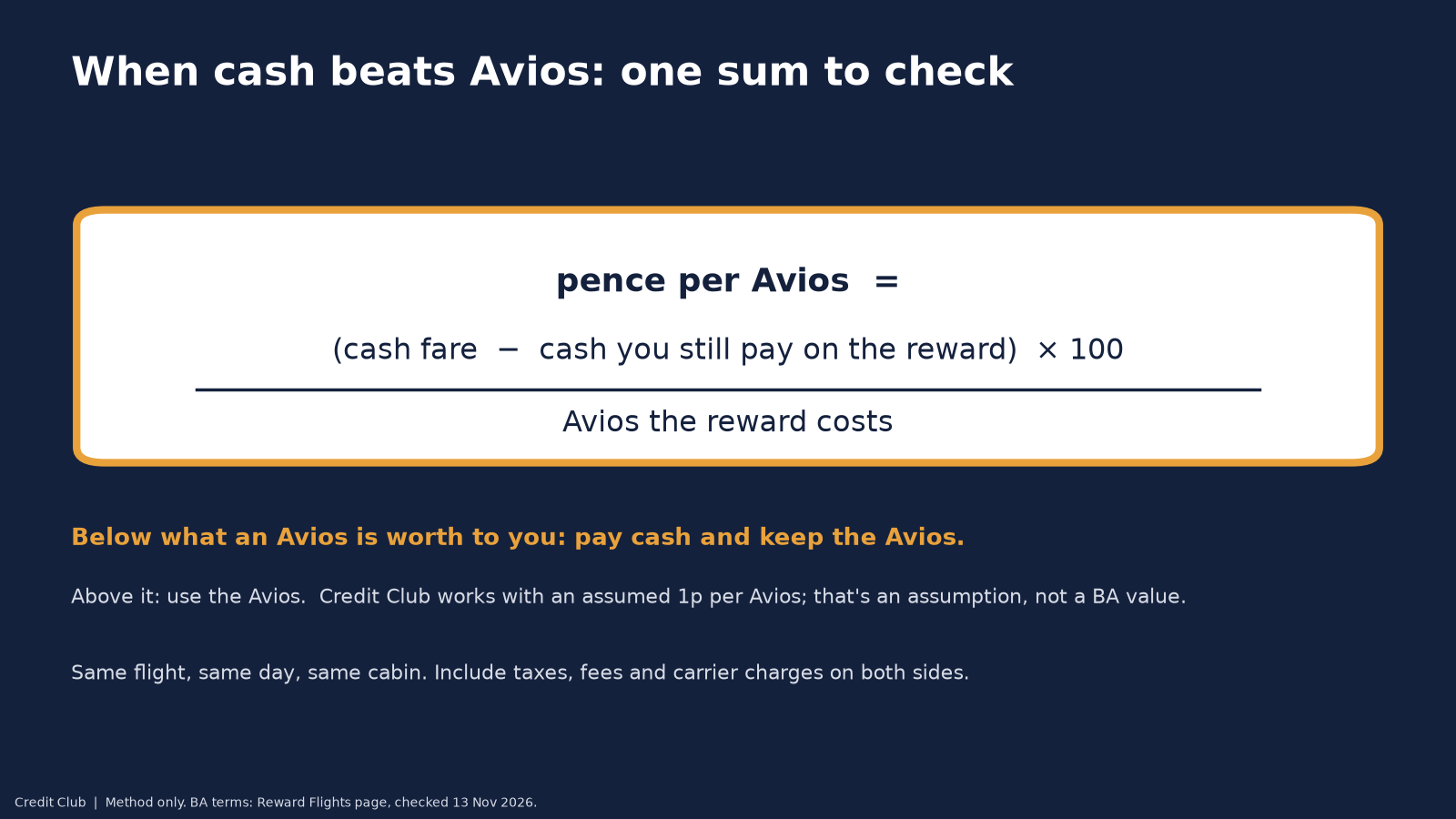
pence per Avios = (cash fare − cash you still pay on the reward) × 100 ÷ Avios used
If the answer is lower than your value for an Avios, pay cash and keep the Avios. In this article we use an assumed value of 1p per Avios. That's a Credit Club working figure, not a BA value, and you can swap in your own.
What we'd do first: on ba.com, price the same flight, same day and same cabin twice: once as a cash fare, once as a reward. Write down both totals, including all taxes, fees and carrier charges, and the date and time you checked. Prices change, so a screenshot helps.
Why taxes and charges change the answer
A reward is rarely "free". BA's Reward Flights carry "a fixed cash cost, inclusive of taxes, fees and carrier charges plus an Avios amount" (BA Reward Flights, checked 13 Nov 2026). BA's own examples, "correct as of May 2026":
- Europe, the UK and Ireland: from 10,000 Avios + £2.50 each way
- Further afield: from 55,000 Avios + £150 return (BA doesn't name the cabin)
- Club World (long-haul business): from 154,000 Avios + £350 return
Those examples are dated and may have changed, so we don't use them in the maths below. If you ignore the cash part, you overstate what your Avios are doing. On partner airlines the charges are "variable rather than fixed", so the sum has to use the figure at checkout.
Worked examples
Every figure in this section is hypothetical: invented round numbers for the reward prices and the cash fares, chosen to show how the answer changes. They aren't BA prices or quotes. Use the figures ba.com shows you for your own flight.
| Trip (one person, return) | Reward price (hypothetical) | Cash fare (hypothetical) | Sum | Pence per Avios |
|---|---|---|---|---|
| Europe, economy | 24,000 Avios + £20 | £120 | (£120 − £20) × 100 ÷ 24,000 | 0.42p |
| Europe, economy | 24,000 Avios + £20 | £300 | (£300 − £20) × 100 ÷ 24,000 | 1.17p |
| Long-haul, economy | 60,000 Avios + £200 | £550 | (£550 − £200) × 100 ÷ 60,000 | 0.58p |
| Long-haul, economy | 60,000 Avios + £200 | £900 | (£900 − £200) × 100 ÷ 60,000 | 1.17p |
| Long-haul, business | 170,000 Avios + £500 | £2,000 | (£2,000 − £500) × 100 ÷ 170,000 | 0.88p |
| Long-haul, business | 170,000 Avios + £500 | £3,500 | (£3,500 − £500) × 100 ÷ 170,000 | 1.76p |
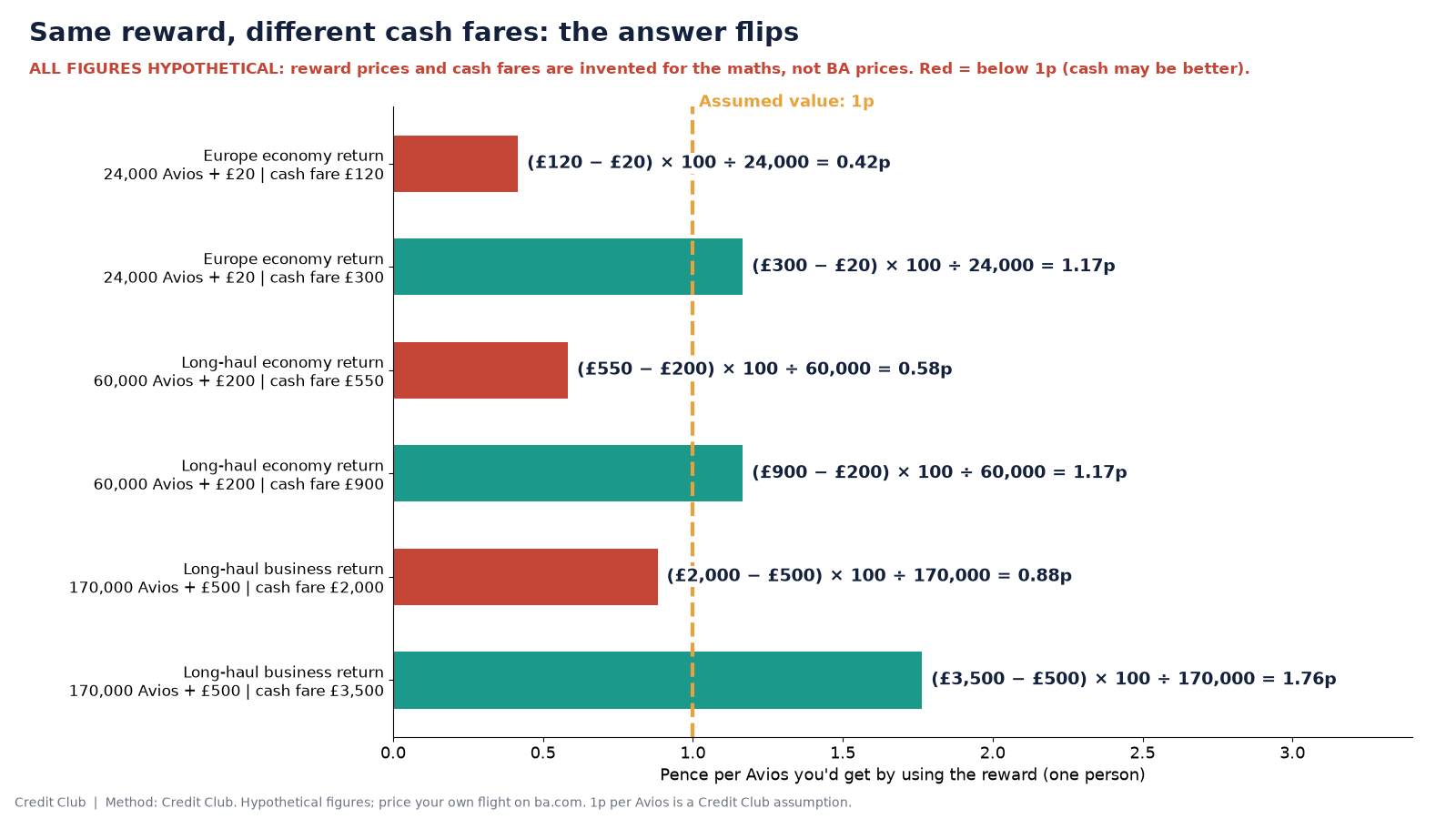
Read the table in pairs. The reward is identical; only the cash fare moves. A cheap off-season European fare makes the reward poor value (0.42p), while the same reward against a school-holiday fare clears 1p. The same pattern holds long-haul, in economy and in business.
The break-even fare: a quicker test
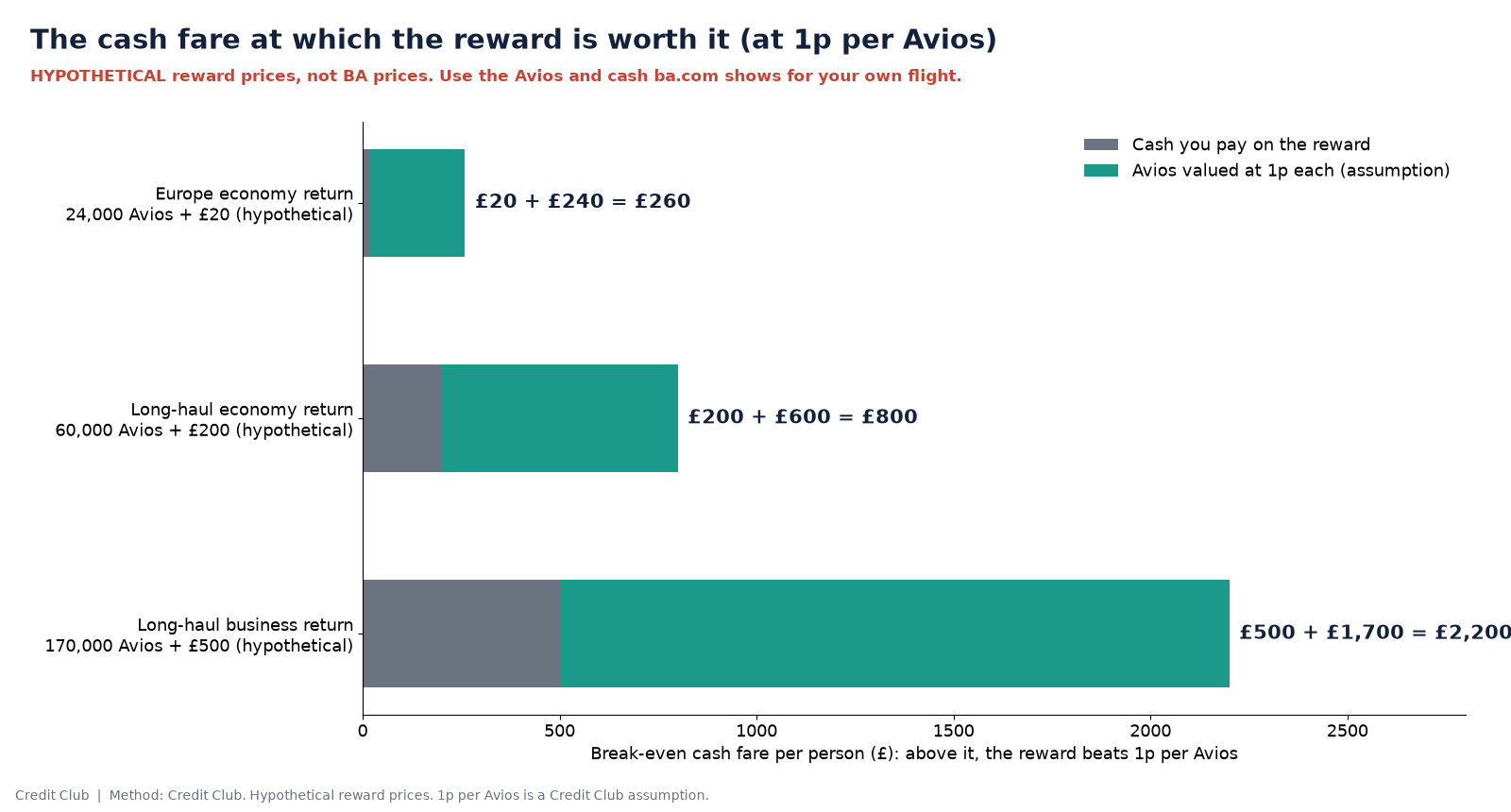
Turn the sum around. At 1p per Avios, the reward is worth using whenever the cash fare is above:
break-even fare = reward cash + (Avios × 1p)
Using the same hypothetical reward prices:
- Europe, economy: £20 + (24,000 × 1p = £240) = £260
- Long-haul, economy: £200 + (60,000 × 1p = £600) = £800
- Long-haul, business: £500 + (170,000 × 1p = £1,700) = £2,200
So in the hypothetical Europe example, if the cash fare for the same flight is under £260, paying cash is the better deal on our assumption. Use the break-even figure when you're comparing several dates: once you know the reward price, you only need to look at the cash fare.
What an Avios is worth to you
The whole method rests on the value you put on an Avios. A few reference points:
- Our assumption: 1p. It's a round figure for comparison, not a promise of what you'll get.
- What it costs to buy one. avios.com advertises "up to 57 Avios / £1" for a straight purchase (avios.com Buy, checked 13 Nov 2026), which works out at 100 ÷ 57 = 1.75p at best. If a redemption gets you less than that, it makes no sense to buy Avios for it. See buying Avios: when a sale makes sense.
- What you'd use them for otherwise. If you're saving for a long-haul business trip that clears 1.5p or 2p, spending Avios on a 0.6p short hop costs you more than it looks.
If your Avios came from an Amex card, the points could have gone elsewhere; see where Amex Membership Rewards points transfer in the UK.
Two adjustments worth making
1. Avios you'd earn on the cash ticket. A cash ticket earns Avios and tier points; a reward ticket booked with Avios works differently. To be precise, subtract the value of the Avios the cash ticket would earn. Hypothetical example: if the hypothetical £550 long-haul fare earned 2,000 Avios, worth £20 at 1p, the sum becomes (£550 − £200 − £20) × 100 ÷ 60,000 = 0.55p. Check the earning on BA's calculator for your fare; we haven't assumed a real figure.
2. Flexibility. BA lets you cancel a reward flight more than 24 hours before the first flight for a refund, less charges. For an Avios & Money booking BA's Conditions of Use say cash and taxes are refunded and Avios re-credited "less the standard redemption charges", and nothing is refunded within 24 hours (BA Club Conditions of Use, Avios & Money clauses 8 and 9, checked 13 Nov 2026). A cheap cash fare may be non-refundable. That can make a slightly lower pence-per-Avios figure worth accepting.
Where Avios tend to beat cash
You can't know until you price your own flight, but the maths explains the patterns:
- Long-haul premium cabins. The Avios price rises, but cash fares often rise faster. In the hypothetical business example, the reward clears 1p once the fare passes £2,200 and reaches 2p at £3,900 (£500 + 170,000 × 2p).
- Two people with a Companion Voucher. The voucher halves the Avios for two (one Avios price, charges for both). Hypothetical example: two business seats at £2,000 each = £4,000 cash, against 170,000 Avios + £1,000 (charges for both). (£4,000 − £1,000) × 100 ÷ 170,000 = 1.76p, double the 0.88p one person gets at the same fare. See how the BA Companion Voucher really works.
- Peak dates booked off-peak. Cash fares on peak dates can be high while an off-peak reward on a nearby date stays at the lower Avios price. See Avios pricing explained for how peak and off-peak work.
Where cash tends to win
- Short, cheap European flights outside the holidays, as in the £120 example.
- Flights where the reward charges are high, such as some partner flights. BA's own page says partner charges are variable; lower fees through Iberia, Qatar or Aer Lingus covers how to compare.
- Sales on cash fares. If a sale drops the fare below the break-even, pay cash.
Three mistakes that skew the sum
- Comparing different flights. A cheap cash fare at 6am against a reward at 6pm isn't a fair test. Use the same flight, or accept that you're paying for the better time.
- Leaving out the reward's cash. In the hypothetical business example, ignoring the £500 makes a £2,000 fare look like 1.18p per Avios instead of 0.88p.
- Using an old price. Cash fares and reward availability move daily. If you checked last week, check again before you book, and note the date and time.
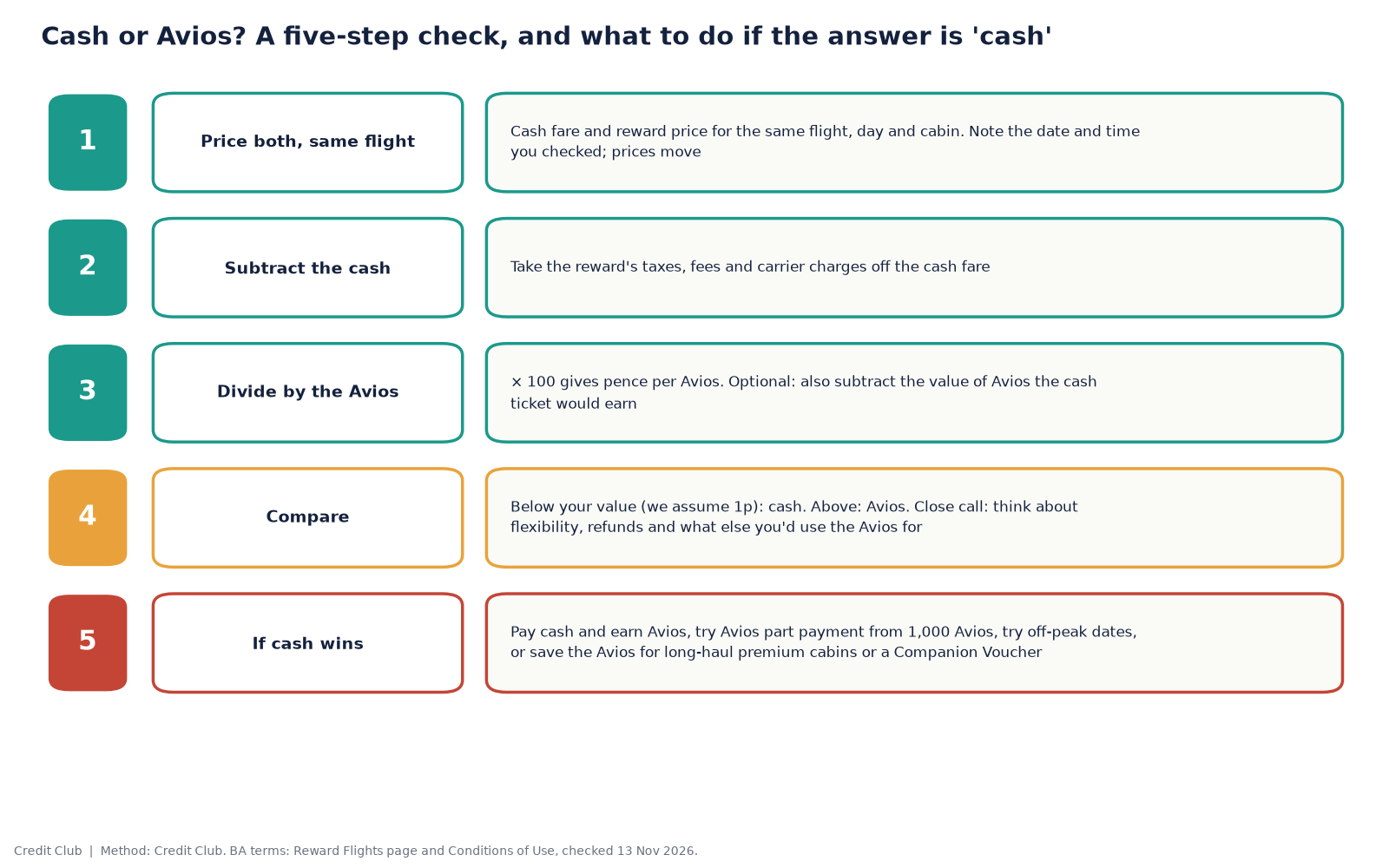
If cash wins: what to do instead
- Pay cash and earn Avios on the ticket.
- Try Avios part payment on the cash fare, from 1,000 Avios, and check its pence per Avios with the same sum.
- Check Avios & Money. It might lower the Avios but raise the cash; see the step test in Avios pricing explained.
- Move the dates to off-peak and run the sum again.
- Save the Avios for a trip where the sum clears your value comfortably.
Booking from the US? The same method, with US programmes and dollars, is in points or cash for flights.
Pence per Avios FAQs
Is 1p per Avios a good value?
It's the working figure we use, not a target. Many readers will want more for long-haul premium trips. Use your own figure if you have one.
Do I include the Avios I'd earn on a cash fare?
For a close call, yes. Use BA's figures for your fare, not a guess.
Should I include seat or bag fees?
Only where they differ between the two options. BA says "Like all Reward Flights, Avios-only flight tickets include one checked bag at 23kg"; compare that with the cash fare you're pricing.