
On this page
- The rule we use
- The three ways to pay
- Test case 1: a cheap domestic fare (hypothetical)
- Test case 2: portal versus transfer (hypothetical)
- Test case 3: heavy surcharges to Europe (hypothetical)
- Test case 4: business class to Europe (published starting price and hypothetical)
- Test case 5: two travelers on a peak date (hypothetical)
- What the test cases show
- Trade-offs
- Fallback
- Points or cash: FAQs
Pay cash when the fare is low, when the award carries heavy surcharges, or when the award price jumps on a busy date. Use points when a premium-cabin cash fare is high and the points price isn't. In between, a card's travel portal, which turns points into a fixed cash value, often beats both. The only way to know is to run the numbers for your trip.
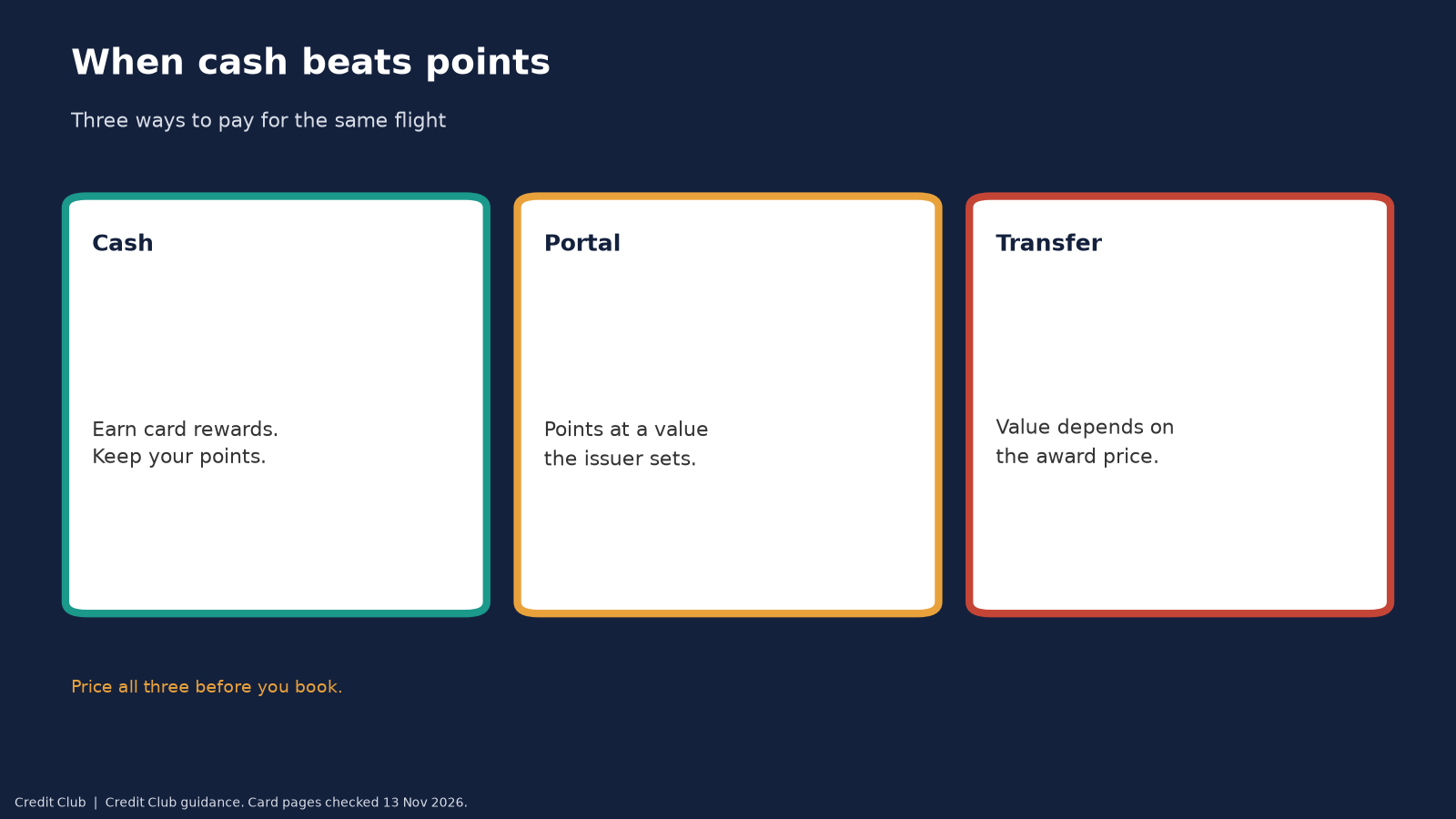
What we'd do first: price your flight three ways: in cash, in your card's travel portal, and as an award with a transfer partner. Then use the cents-per-point formula below.
The rule we use
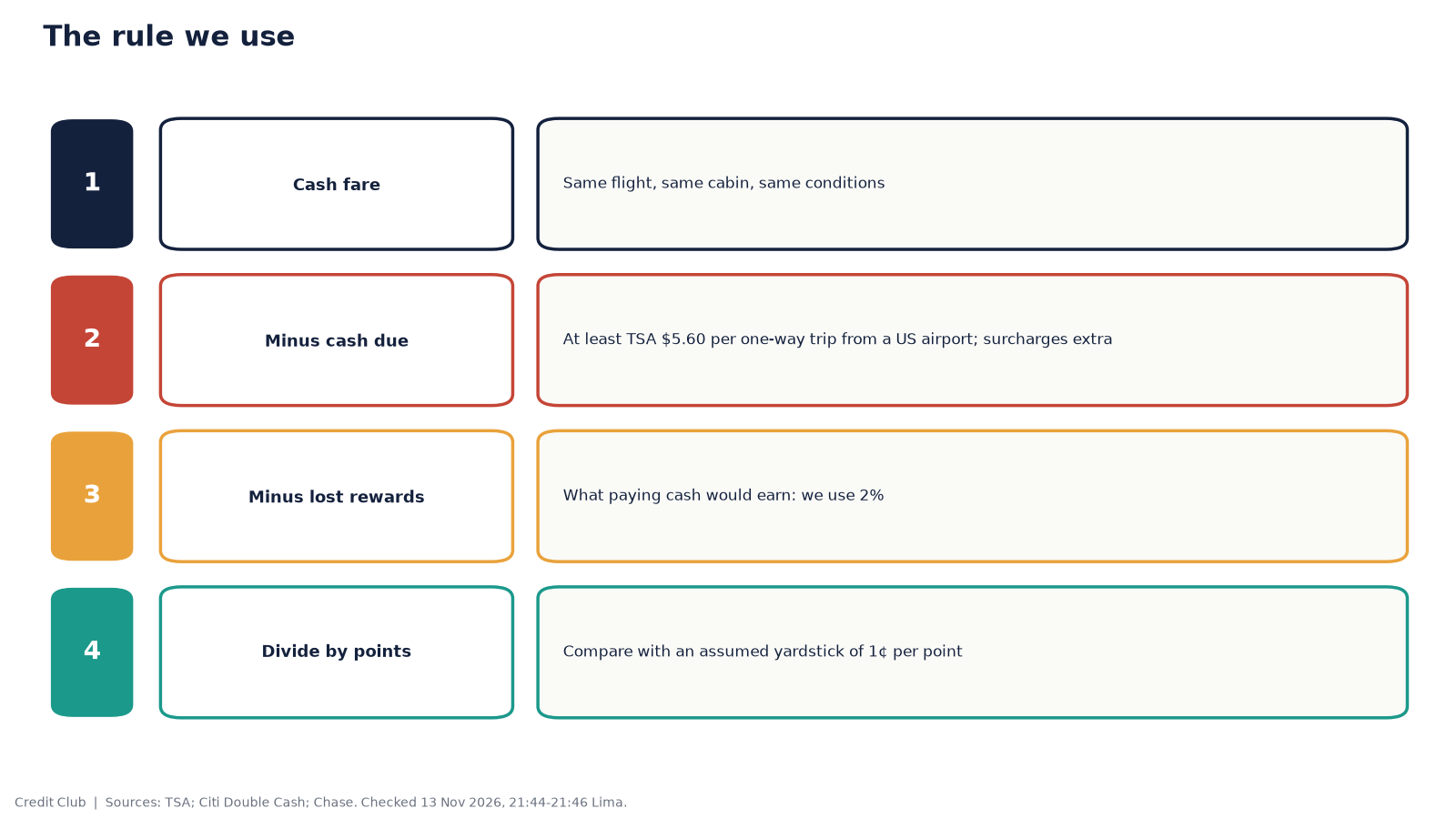
Cents per point = (cash fare − cash due on the award − rewards you'd earn paying cash) ÷ points × 100
We compare the result with an assumed yardstick of 1 cent per point. That's roughly what a fixed-value redemption gives: Chase says that "as a general rule of thumb, one point equates to $0.01 in redeemable value", though it "can fluctuate" (Chase: How to use Ultimate Rewards for travel, checked 13 Nov 2026, 21:44 Lima). It's not a market value, and it's not a promise.
For rewards you'd earn paying cash, we use a flat 2% card as the baseline. Citi describes the Citi Double Cash card as earning "unlimited 2% cash back on purchases: 1% when you buy, 1% as you pay", with a $0 annual fee (Citi Double Cash card, checked 13 Nov 2026, 21:46 Lima; check current rates and fees). Our cents-per-point guide explains each part in detail.
Every award departing a US airport carries cash, too. The TSA security fee "is currently $5.60 per one-way trip in air transportation that originates at an airport in the U.S.", capped at $11.20 per round trip (TSA: Security Fees, checked 13 Nov 2026, 21:46 Lima).
The three ways to pay
- Cash. You pay the fare, earn your card's rewards, and keep your points.
- Portal. You book a paid fare through your card's travel site using points at a rate the issuer sets. Chase's Sapphire Preferred page also describes Points Boost: "your points are worth up to 1.5x on top-booked hotels and flights with select airlines through Chase Travel", with offers "available on a rotating basis" (Chase Sapphire Preferred benefits, checked 13 Nov 2026, 21:52 Lima). Capital One lets you cover "an eligible recent travel purchase" with miles "within 90 days of purchase" (Capital One: ways to redeem Venture miles, checked 13 Nov 2026, 21:47 Lima).
- Transfer. You move points to an airline program and book an award. Value depends on the award price, and transfers are generally final.
Test case 1: a cheap domestic fare (hypothetical)
New York (LGA) to Chicago, one way, one traveler, economy.
- Cash: $129. Award: 15,000 miles + $5.60.
- Lost rewards: 2% × $129 = $2.58.
- Value: ($129 − $5.60 − $2.58) ÷ 15,000 × 100 = 0.81 cents.
Verdict: cash. Below the yardstick. Even at a 1-cent portal rate, you'd spend 12,900 points instead of 15,000 miles. Cheap fares rarely make good awards.
Test case 2: portal versus transfer (hypothetical)
Atlanta to Denver, one way, one traveler, economy, Chase points.
- Cash: $400. Award via a transfer partner: 30,000 points + $5.60.
- Transfer value: ($400 − $5.60 − $8) ÷ 30,000 × 100 = 1.29 cents.
- Portal at 1 cent: 40,000 points. Value: ($400 − $8) ÷ 40,000 × 100 = 0.98 cents.
- Portal with a 1.5x Points Boost offer, if one appears on this flight: about 26,667 points. Value: ($400 − $8) ÷ 26,667 × 100 = 1.47 cents.
Verdict: depends on the offer. The transfer beats the standard portal rate. A Points Boost offer, if shown, beats the transfer, and the paid ticket booked through a portal may also earn airline miles. Check both before moving points.
Test case 3: heavy surcharges to Europe (hypothetical)
Boston to London, one way, one traveler, economy.
- Cash: $780. Award: 35,000 miles + $420 in taxes and carrier surcharges.
- Lost rewards: 2% × $780 = $15.60.
- Value: ($780 − $420 − $15.60) ÷ 35,000 × 100 = 0.98 cents.
Verdict: cash, or a different program. More than half the fare is still due in cash. Delta's award page notes that international awards "may include up to $600 for foreign government taxes and fees and/or carrier-imposed fees" (Delta: Travel with Miles, checked 13 Nov 2026, 21:45 Lima). Price the same flight in a program that passes on smaller surcharges before deciding.
Test case 4: business class to Europe (published starting price and hypothetical)
New York to Paris, one way, one traveler, business class.
- Cash: $3,200 (hypothetical).
- Award: 60,000 points (Aeroplan published price for 0–4,000 miles flown: fixed on most partners, "starting at" on Air Canada and Select Partners such as United) + $120 in taxes and fees (hypothetical), plus a partner booking fee shown at checkout (Aeroplan Flight Reward Chart, PDF, checked 13 Nov 2026, 21:47 Lima).
- Lost rewards: 2% × $3,200 = $64.
- Value: ($3,200 − $120 − $64) ÷ 60,000 × 100 = 5.03 cents.
Verdict: points, if you'd buy business anyway. If you'd really fly economy, compare with the economy fare instead and the value falls sharply. Availability at the published price is never guaranteed.
Test case 5: two travelers on a peak date (hypothetical)
Dallas to Orlando, round trip, two travelers, economy, school holiday week.
- Cash: $450 each, $900 total. Award: 45,000 miles each + $11.20 each, so 90,000 miles + $22.40.
- Lost rewards: 2% × $900 = $18.
- Value: ($900 − $22.40 − $18) ÷ 90,000 × 100 = 0.95 cents.
Verdict: cash. Dynamic award prices often rise on busy dates faster than cash fares. Two seats double the points without improving the rate.
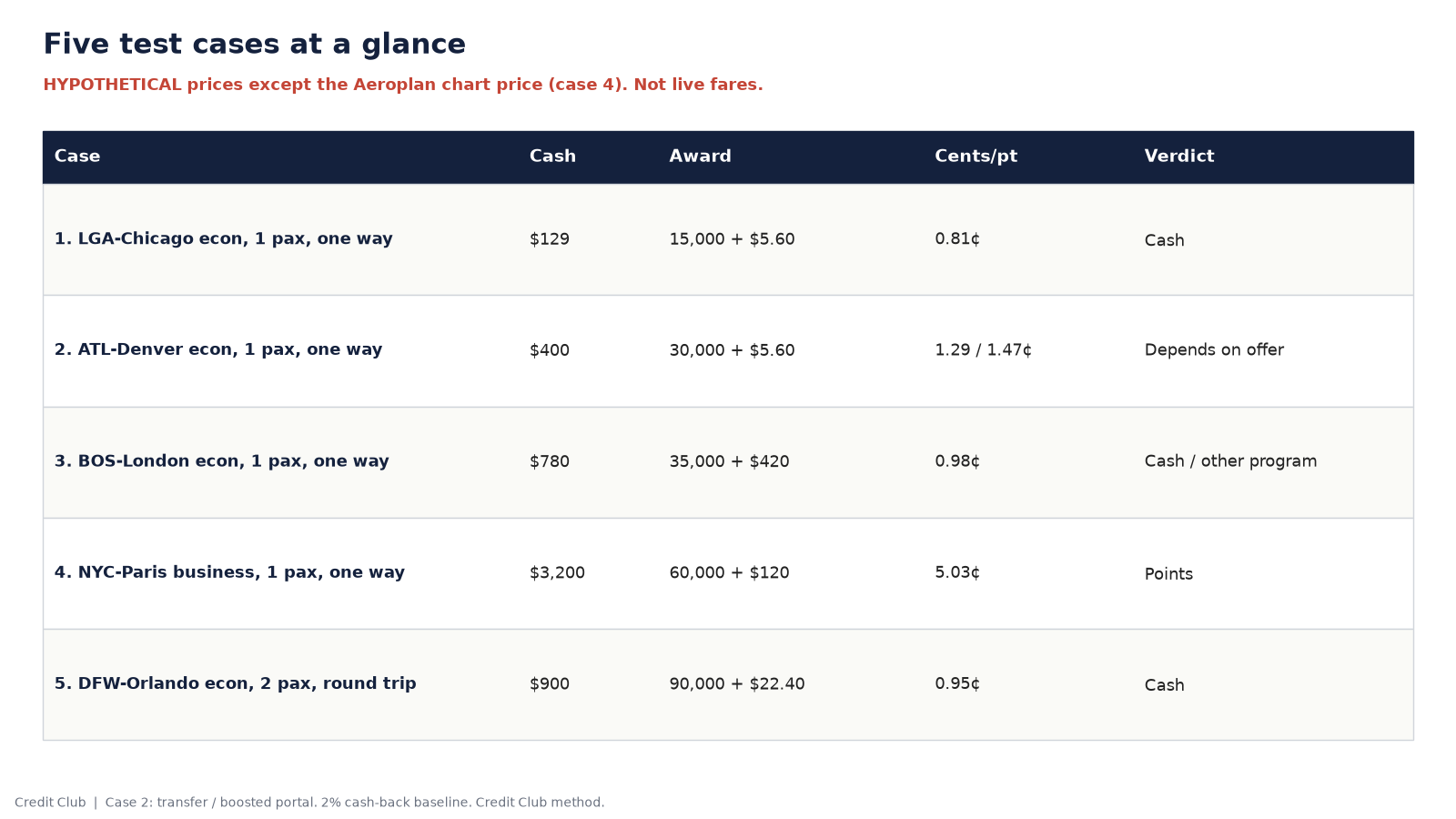
| Test case (one way unless stated) | Cash | Award | Cents per point | Verdict |
|---|---|---|---|---|
| 1. LGA–Chicago economy, 1 traveler (hypo) | $129 | 15,000 + $5.60 | 0.81¢ | Cash |
| 2. Atlanta–Denver economy, 1 traveler (hypo) | $400 | 30,000 + $5.60 | 1.29¢ transfer / 1.47¢ boosted portal | Depends on offer |
| 3. Boston–London economy, 1 traveler (hypo) | $780 | 35,000 + $420 | 0.98¢ | Cash or other program |
| 4. NYC–Paris business, 1 traveler (chart + hypo) | $3,200 | 60,000 + $120 | 5.03¢ | Points |
| 5. Dallas–Orlando round trip, 2 travelers (hypo) | $900 | 90,000 + $22.40 | 0.95¢ | Cash |
What the test cases show
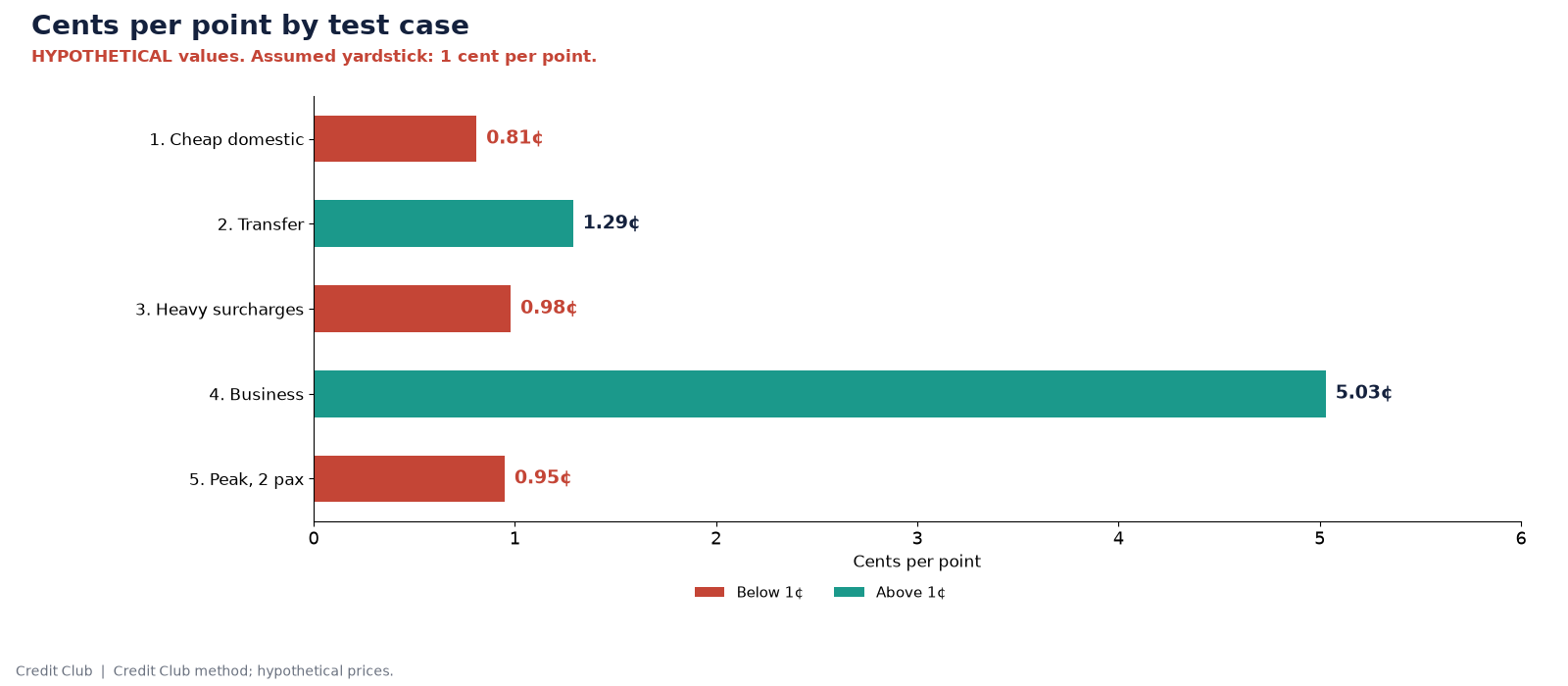
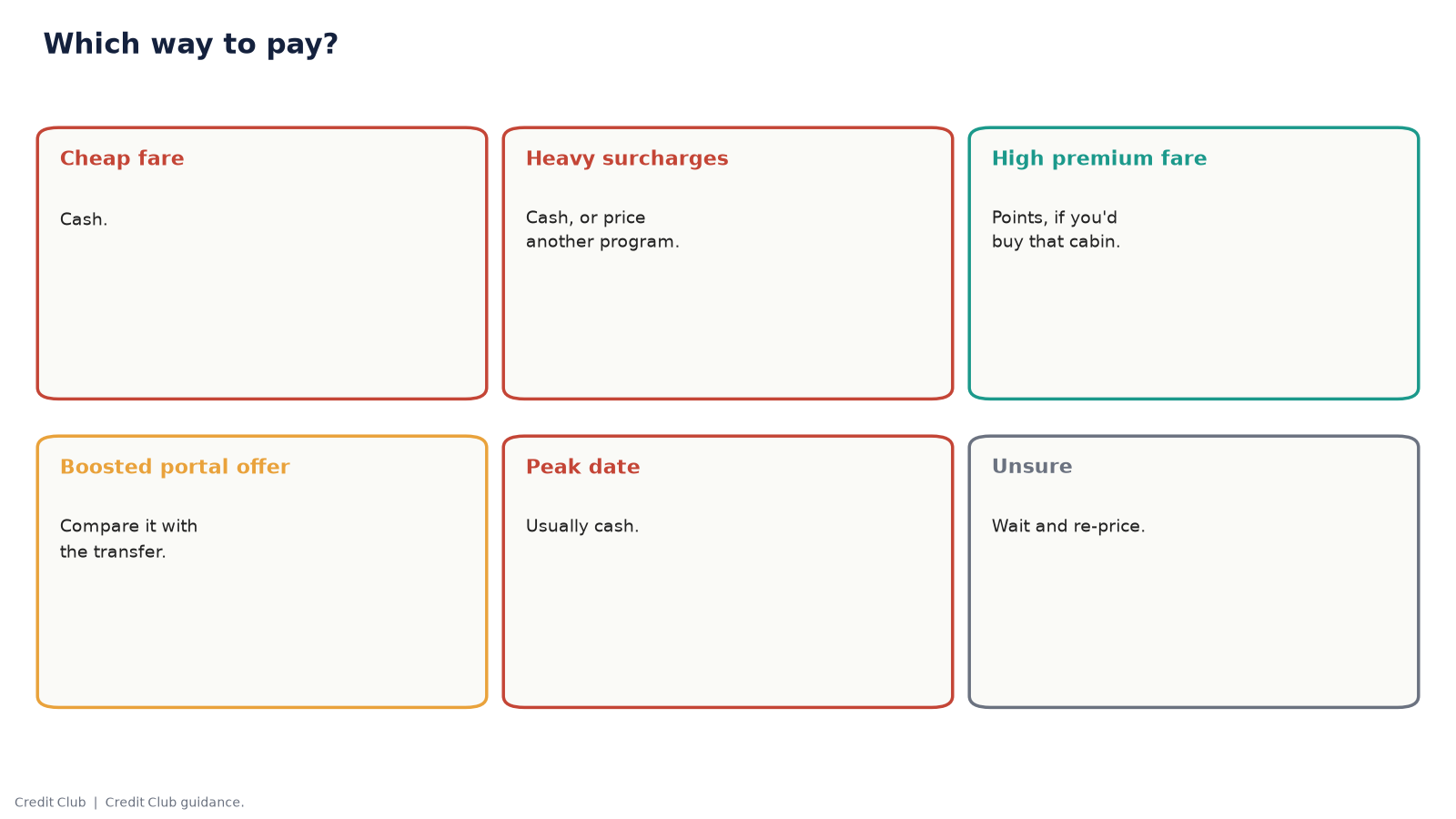
Points did best when the cash fare was high relative to the points price: a premium cabin on a chart-priced route. Cash won when the fare was cheap, when surcharges were heavy, or when a busy date pushed the points price up. The portal sat in the middle: never spectacular at its standard rate, but predictable, and potentially better than a transfer when a boosted offer appears.
Trade-offs
- Earning on paid fares. A cash or portal booking may earn airline miles that an award doesn't. That nudges close calls toward cash.
- Flexibility. Some awards can be changed or cancelled with the miles returned; some paid fares can't. Compare like for like.
- Points you'll never use are worth nothing. If your balance would otherwise sit idle, a 0.9-cent redemption may still be sensible. Just know the trade.
- Prices move. All of these numbers can change within hours.
Fallback
If neither option looks good, wait. Set a fare alert, check the award calendar across nearby dates, and price the same flight in another transfer partner. If you need to book now, pay cash with a card that earns well on airfare and keep your points for a better redemption. For why the same seat costs different amounts in different programs, see award charts versus dynamic pricing.
Points or cash: FAQs
Is it ever worth redeeming below 1 cent?
Sometimes, if you value keeping cash more than points, or the points would otherwise go unused. Just do it knowingly.
Should I always check the portal?
Yes, if your card has one. It's a quick benchmark, and boosted offers rotate.
Do these numbers apply to my trip?
No. They're hypothetical. Use the formula with your own prices.
For which currencies reach which airlines, see transferable points explained.