
On this page
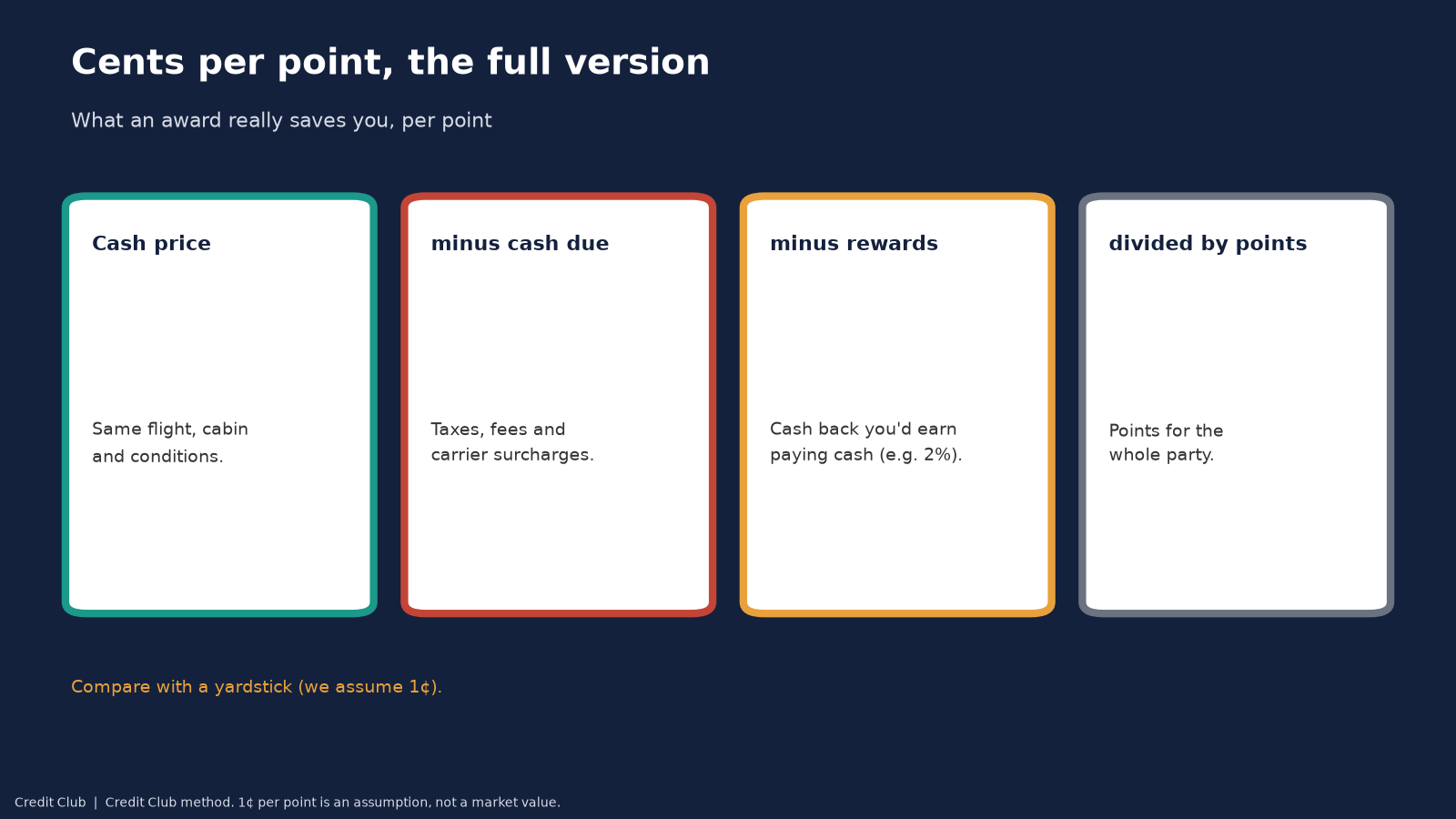
Take the cash price of the ticket you'd otherwise buy, subtract the cash you still pay on the award (taxes, fees and any carrier surcharges), subtract the rewards you'd have earned by paying cash, then divide by the points the award costs. Multiply by 100 to get cents per point. If the result is comfortably above the value you'd get from a simple redemption (we use an assumed 1 cent per point as the yardstick), the award is probably worth it.
What we'd do first: open two tabs for the same flight, one priced in cash and one priced in points. Write down the cash fare, the points price and the cash due on the award. Those three numbers are all you need to start.
The formula
Cents per point = (cash price − cash due on the award − rewards you give up) ÷ points required × 100
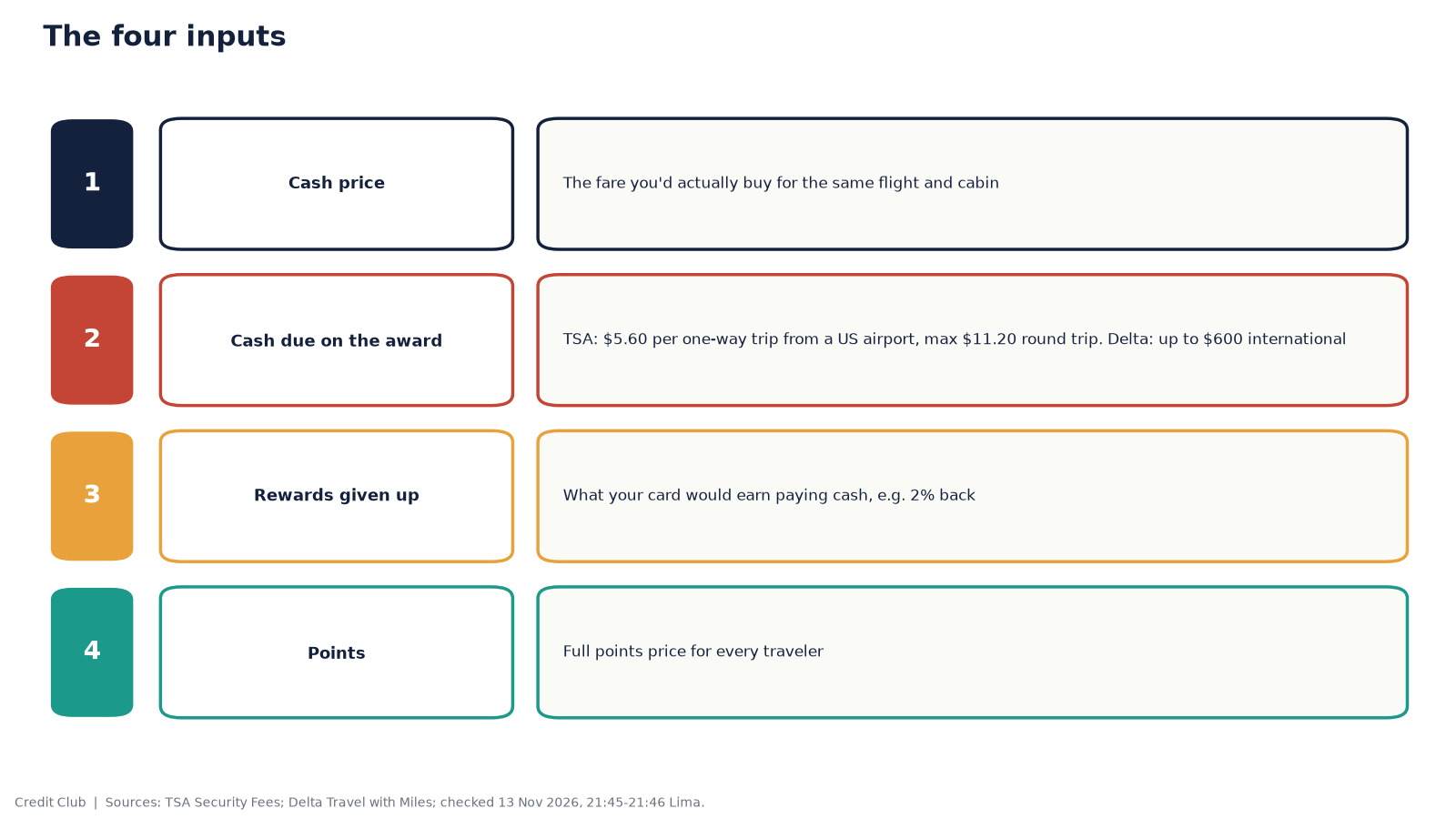
Each part matters:
- Cash price. The fare for the same flight, cabin and conditions you'd actually buy. Don't compare an award with a flexible fare you'd never pay for.
- Cash due on the award. Awards aren't free. Every award departing a US airport carries at least the September 11 Security Fee, and international awards can carry much more.
- Rewards you give up. If you'd pay cash with a card that earns 2% back, an award costs you that 2% too. This is the part most calculators leave out.
- Points required. The full points price for everyone traveling.
Step 1: find the cash due on the award
Start with the floor. The TSA says its security fee "is currently $5.60 per one-way trip in air transportation that originates at an airport in the U.S., except that the fee imposed per round trip shall not exceed $11.20" (TSA: Security Fees, checked 13 Nov 2026, 21:46 Lima). The federal rule says the fee "must be imposed on passengers who obtained the ticket for air transportation with a frequent flyer award" (eCFR: 49 CFR 1510.5, checked 13 Nov 2026, 21:46 Lima). So even the cheapest domestic award costs some cash.
International awards are where the cash part grows. Delta's own award page says redemption "requires payment of at least $11.20 in U.S. government taxes and fees for domestic itineraries and may include up to $600 for foreign government taxes and fees and/or carrier-imposed fees for international itineraries" (Delta: Travel with Miles, checked 13 Nov 2026, 21:45 Lima). American's terms likewise make taxes and surcharges payable by the member (AAdvantage terms and conditions, effective March 1, 2026, checked 13 Nov 2026, 21:45 Lima). Always read the cash total on the final award screen, not the headline points price.
Step 2: count the rewards you give up
When you pay cash with a rewards card, you earn something back. When you redeem points, you don't earn on the part covered by points. That's a real cost.
Our default baseline is a flat 2% cash-back card. Citi, for example, describes the Citi Double Cash card as earning "unlimited 2% cash back on purchases: 1% when you buy, 1% as you pay", with a $0 annual fee (Citi Double Cash card, checked 13 Nov 2026, 21:46 Lima; check current rates and fees). On a $320 fare, 2% is $6.40. If your everyday card earns more on airfare, use that rate instead. If you'd also earn airline miles on a paid ticket and not on an award, you can add a rough value for those too; we leave them out to keep the method simple.
Step 3: pick a yardstick
A cents-per-point figure only means something when you compare it with your alternatives. For transferable US points, the simplest alternative is a fixed-value redemption. Chase says that "as a general rule of thumb, one point equates to $0.01 in redeemable value", though it "can fluctuate" by redemption (Chase: How to use Ultimate Rewards for travel, checked 13 Nov 2026, 21:44 Lima). Capital One lets you cover "an eligible recent travel purchase" with miles "within 90 days of purchase" (Capital One: ways to redeem Venture miles, checked 13 Nov 2026, 21:47 Lima).
So we use 1 cent per point as an assumed yardstick. It isn't a market price and it isn't a promise of value. It's the floor we'd want an airline award to clear before transferring points away from a simple, fixed-value use.
Worked examples (hypothetical)
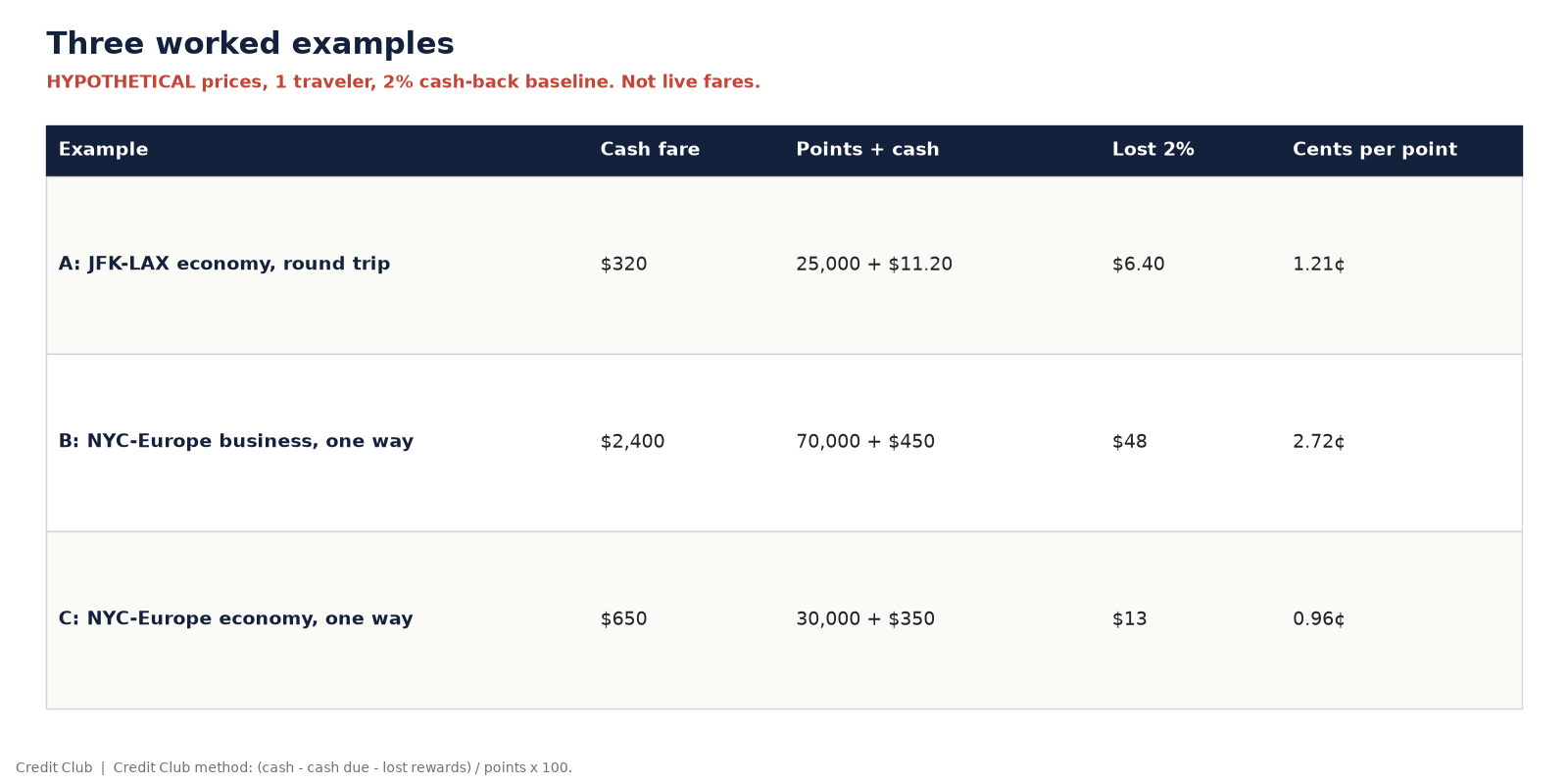
All three examples use hypothetical prices, one traveler, and a 2% cash-back baseline. They show the method, not current fares.
Example A: domestic economy, New York (JFK) to Los Angeles round trip.
- Cash fare: $320 (hypothetical).
- Award: 25,000 miles + $11.20 (hypothetical miles; $11.20 is the TSA round-trip cap).
- Rewards given up: 2% × $320 = $6.40.
- Value: ($320 − $11.20 − $6.40) ÷ 25,000 × 100 = 1.21 cents per point.
That clears the 1-cent yardstick, but only just. Leave out the lost cash back and you'd get 1.24 cents, which overstates the value slightly.
Example B: business class, New York to Europe one way, moderate surcharges.
- Cash fare: $2,400 (hypothetical).
- Award: 70,000 miles + $450 in taxes and carrier surcharges (hypothetical).
- Rewards given up: 2% × $2,400 = $48.
- Value: ($2,400 − $450 − $48) ÷ 70,000 × 100 = 2.72 cents per point.
This is the kind of award where points tend to shine: a high cash fare against a points price that doesn't rise as fast.
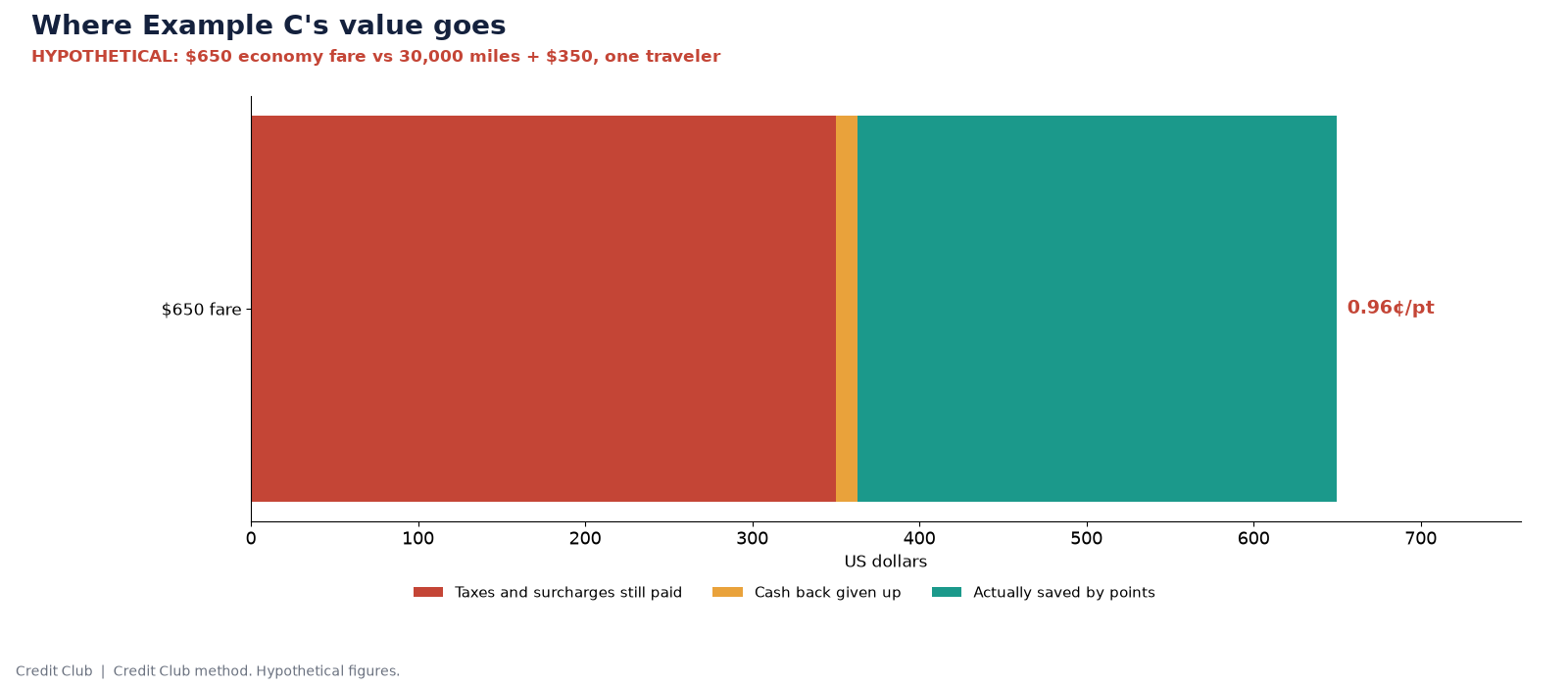
Example C: economy to Europe one way, heavy surcharges.
- Cash fare: $650 (hypothetical).
- Award: 30,000 miles + $350 in taxes and carrier surcharges (hypothetical).
- Rewards given up: 2% × $650 = $13.
- Value: ($650 − $350 − $13) ÷ 30,000 × 100 = 0.96 cents per point.
Below the yardstick. Here the surcharge does most of the damage: you'd pay more than half the cash fare anyway and spend 30,000 points to save the rest.
| Example (hypothetical) | Cash fare | Points + cash on award | Lost 2% | Cents per point |
|---|---|---|---|---|
| A: JFK–LAX economy round trip, 1 traveler | $320 | 25,000 + $11.20 | $6.40 | 1.21¢ |
| B: NYC–Europe business one way, 1 traveler | $2,400 | 70,000 + $450 | $48 | 2.72¢ |
| C: NYC–Europe economy one way, 1 traveler | $650 | 30,000 + $350 | $13 | 0.96¢ |
For two or more travelers
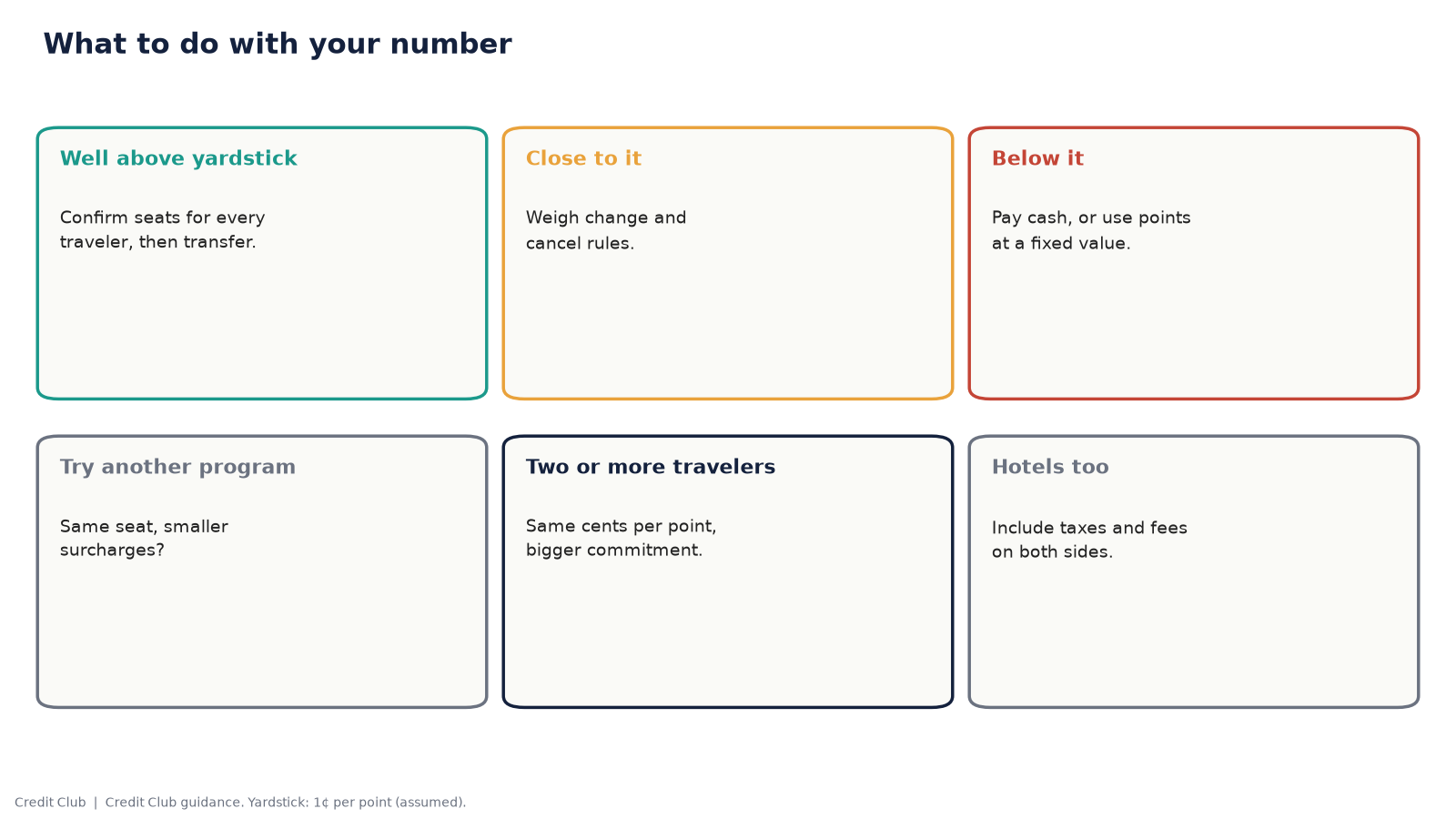
The math doesn't change per person, but the totals do. Two travelers on Example B would spend 140,000 miles and $900 in cash to avoid $4,800 in fares, giving up $96 in cash back. The cents-per-point figure stays at 2.72, but the decision is bigger: 140,000 points is a large share of most balances, and two award seats on the same flight are harder to find than one. Always check that the full party can book before you transfer anything.
Trade-offs
- Higher isn't always better for you. A 3-cent business-class award only beats cash if you'd otherwise have paid for business class. If you'd really fly economy, compare with the economy fare.
- Points you transfer are committed. Transfers to airline programs are generally final, so a strong cents-per-point figure on a seat that disappears before you book is worth nothing. Find the seat first.
- Flexibility has value. Delta lets members change or cancel most awards departing the US or Canada without a redeposit fee, excluding Basic Economy, per the same Delta page. Other programs differ, so a cheaper but more restrictive award may be worth less than the numbers suggest.
- Award prices move. American's terms say awards "may be withdrawn or subject to increased mileage requirements", and Delta says awards "are subject to capacity controls". A figure you calculated yesterday may not hold today.
If the number comes out below your yardstick
Pay cash and keep the points, or use them at a fixed value. Two common fallbacks: book through your card's travel portal at the issuer's rate, or cover a paid travel purchase with points where your card allows it. Both give a predictable value. You can also try a different program for the same flight: an airline that adds smaller surcharges on the same route can turn Example C into a better deal. Our award charts versus dynamic pricing guide explains why the same seat can cost very different amounts in different programs.
A quick checklist
- Same flight, same cabin, same conditions in cash and in points.
- Read the cash total on the final award screen.
- Subtract the rewards you'd have earned paying cash.
- Compare the result with your yardstick (we assume 1 cent).
- Confirm availability for every traveler before transferring.
Cents per point: FAQs
What's a "good" cents-per-point figure?
There's no official benchmark. We use an assumed 1 cent per point as the floor for transferable points because issuers commonly offer about that through fixed-value redemptions; anything well above it is worth a closer look.
Should I include the miles I'd earn on a paid ticket?
You can. It makes the award look slightly worse. We leave them out by default because their value depends on whether you'd ever use them.
Does this work for hotels?
Yes. Use the cash rate including taxes and resort fees, subtract any fees still due on the award night, subtract lost card rewards, and divide by the points.
Does the TSA fee apply to every award?
Per TSA and the federal rule above, it applies to air transportation originating at US airports, including tickets obtained with frequent flyer awards. Check the fee on the publishing date, as it can change.
For how the main US currencies reach each airline, see our transferable points explained guide, and for when the simplest answer is to pay cash, see when cash beats points.