
On this page
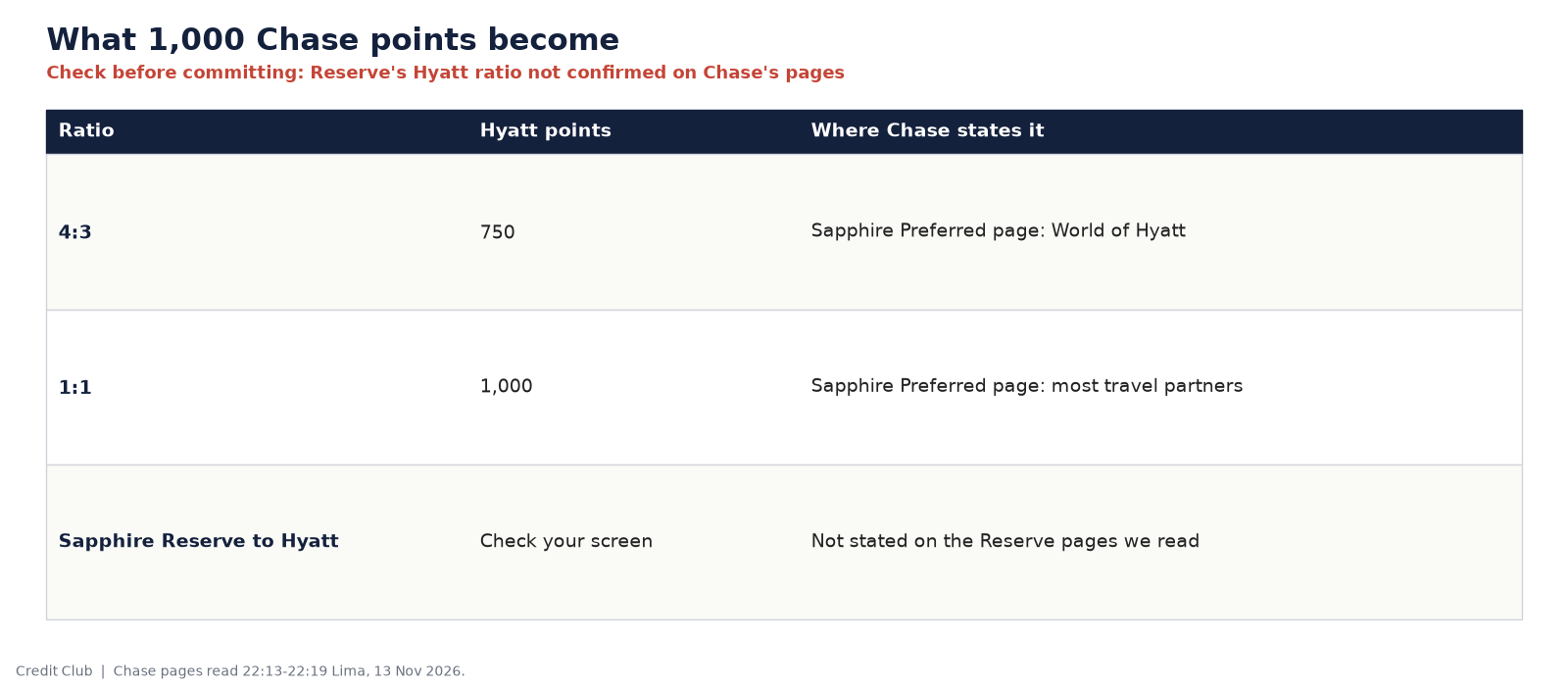
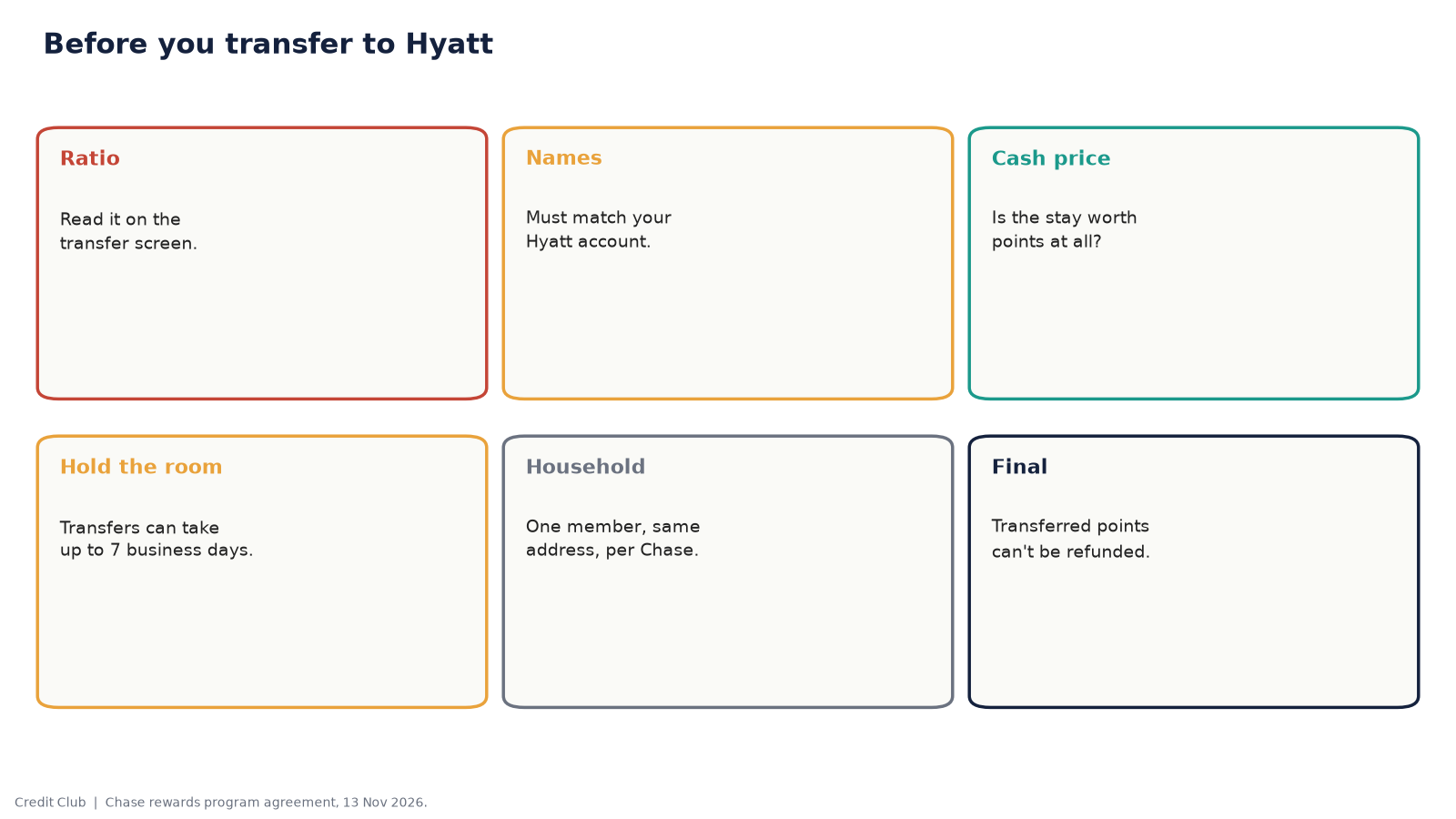
On Chase's own Sapphire Preferred page, points transfer to World of Hyatt at 4:3, so 1,000 Chase points become 750 Hyatt points. Most other Chase partners stay at 1:1. Sapphire Reserve cardholders are widely reported to keep 1:1 to Hyatt, but we couldn't find that ratio on Chase's own pages, so check the transfer screen before you move anything. Chase's rules let you move points between your own cards and to one household member, which is how couples combine points before a transfer.
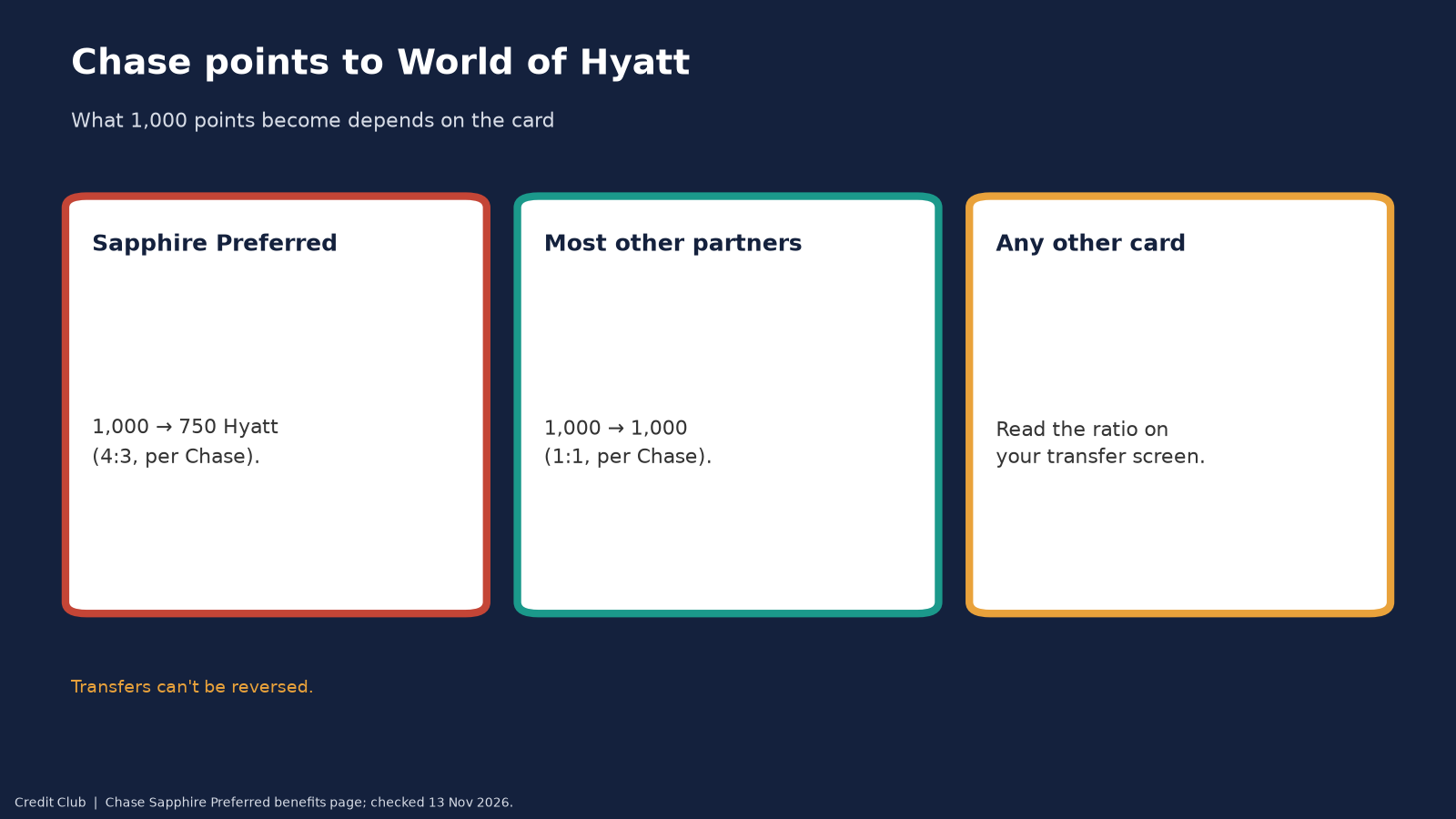
What we'd do first: sign in, open the transfer page from the card that holds the points, choose World of Hyatt and read the ratio Chase shows before you enter an amount. Transfers can't be reversed.
What Chase says about the ratio
Chase's Sapphire Preferred page says: "Chase Ultimate Rewards® points transfer to most travel partners at a rate of 1:1, that means 1,000 points equals 1,000 partner points. Your Ultimate Rewards points will transfer to World of Hyatt at a rate of 4:3. That means if you transfer 1,000 Ultimate Rewards® points, you will get 750 World of Hyatt points." It adds that accounts opened before June 15, 2026 transferred at 1:1 "through September 30, 2026" (Chase Sapphire Preferred benefits, checked 13 Nov 2026, 22:13 Lima). That date has passed.
Chase lists three cards that can transfer to partners: "Sapphire Preferred®, Sapphire Reserve®, Ink Business Preferred®" (Chase: how to transfer Ultimate Rewards points, checked 13 Nov 2026, 22:19 Lima). The Sapphire Reserve pages we read (product page, benefits page and rewards agreement) don't state a Hyatt ratio. Independent sites report that Reserve still transfers at 1:1 and that Ink Business Preferred moved to 4:3; we treat both as unconfirmed until you see the ratio in your own account.
Moving points within your household
Chase's rewards agreements set out two different moves:
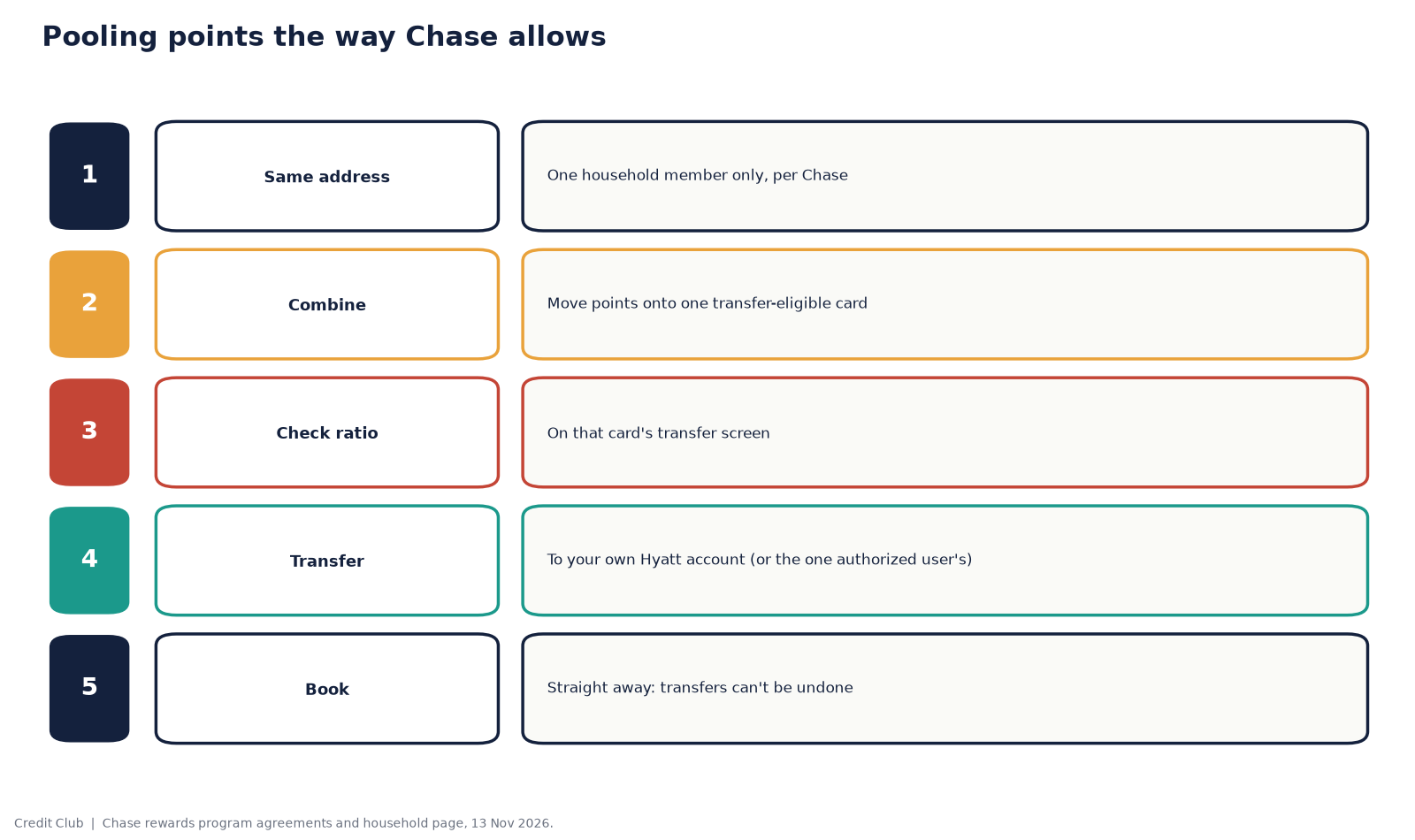
- Combining points between Chase cards. "You can move your points, but only to another Chase card with Ultimate Rewards belonging to you or one member of your household" (Chase Sapphire Reserve rewards program agreement, checked 13 Nov 2026, 22:19 Lima). Chase's household guide adds that the other person "need[s] to share the same address" and that "you can only designate one person to share points with" (Chase: combine points in your household, checked 13 Nov 2026, 22:14 Lima).
- Transferring to a partner. Points can go only "to participating frequent travel program accounts belonging to you or one additional household member who is listed on your account as an authorized user". Transfers are in "1,000-point increments", "Most point transfer requests process by the next business day, but it may take up to 7 business days", and "Once points are transferred, they can't be refunded".
So the legal route for a couple is: move points from one partner's Chase card to the other's card at the same address, then transfer from that card to that person's own Hyatt account (or to the one authorized user's account). Which ratio applies is the one shown on the transfer screen of the card you transfer from. If you hold both a Preferred and a Reserve, combining points onto the Reserve before transferring is a move Chase's rules allow; check the Hyatt ratio on the Reserve's transfer screen before you commit.
Is a 4:3 transfer still worth it? (hypothetical)
Hyatt keeps a published chart with "fixed point thresholds rather than moving to dynamic pricing for award nights", now with five levels in each of eight categories (Hyatt newsroom, February 25, 2026, checked 13 Nov 2026, 21:48 Lima). We couldn't load Hyatt's chart page, so the prices below are hypothetical.
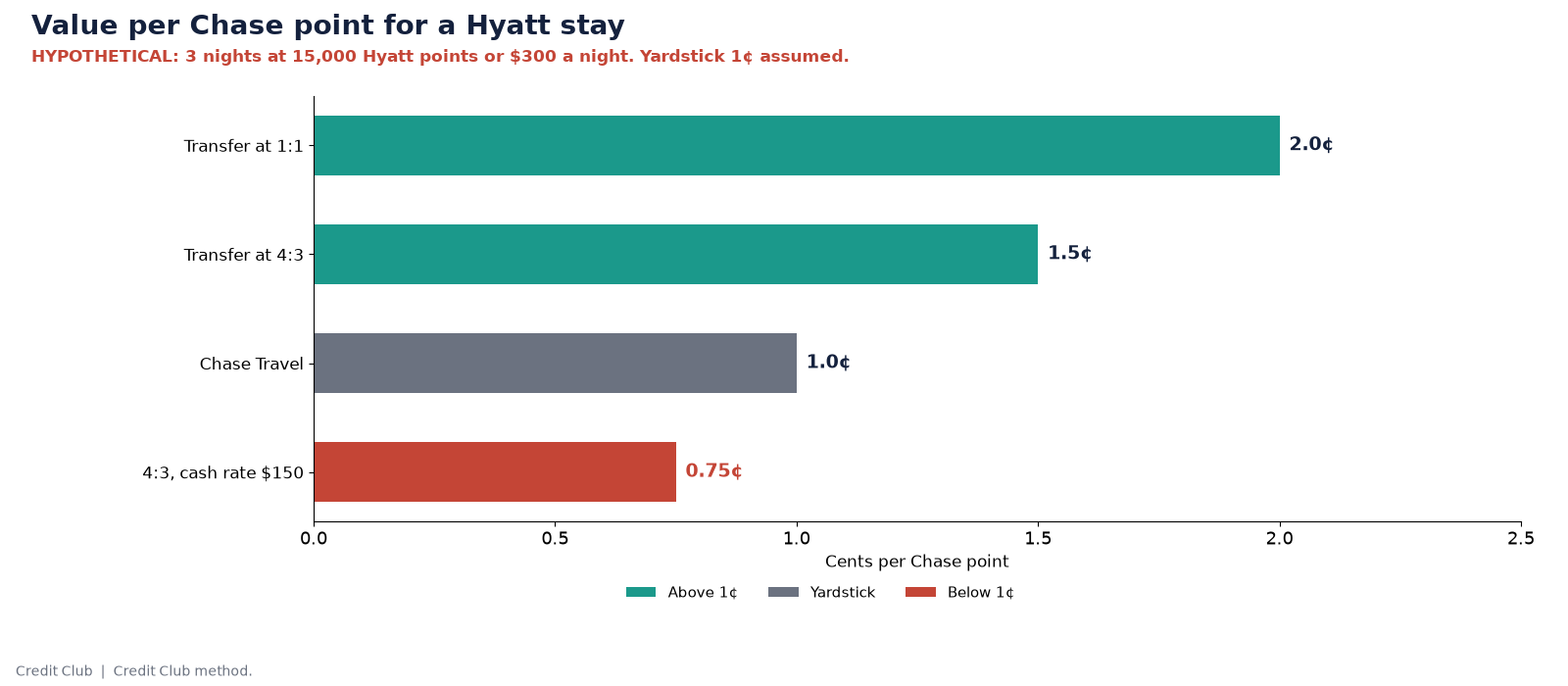
Say a hotel costs 15,000 Hyatt points a night, or $300 cash (both hypothetical), for three nights:
| Route (hypothetical) | Chase points needed, 3 nights | Value per Chase point |
|---|---|---|
| Transfer at 1:1 | 45,000 | 2.0¢ ($900 ÷ 45,000) |
| Transfer at 4:3 | 60,000 | 1.5¢ ($900 ÷ 60,000) |
| Chase Travel at 1¢ (Preferred standard) | 90,000 | 1.0¢ |
Even at 4:3, the transfer beats our assumed 1¢ yardstick in this example. It's worse when the cash rate is low: at $150 a night (hypothetical), 4:3 gives 0.75¢ per point and booking with cash or Chase Travel wins. Run your own numbers with our cents-per-point guide.
A worked household example (method only)
Two partners live together. One holds a Sapphire Preferred with 40,000 points; the other holds a Sapphire Reserve with 20,000 points. They want 45,000 Hyatt points for three nights.
- The Reserve holder checks the Hyatt ratio on the Reserve's transfer screen.
- If it shows 1:1, the Preferred holder moves 25,000 points to the Reserve card ("Combine points"), which Chase allows for one household member at the same address.
- The Reserve holder transfers 45,000 points to their own World of Hyatt account and books.
If the Reserve screen shows 4:3 too, stop: 60,000 Chase points would be needed, and the cash price may be the better deal. This is a method, not a booking we made.
Mistakes we'd avoid
- Transferring "just in case". Hyatt points sit in your Hyatt account once moved, and Chase won't take them back. Transfer when you have a room to book.
- Assuming the ratio. The ratio differs by card and has changed this year. Read it on the screen every time.
- Combining with the wrong person. Chase allows one household member at the same address. A friend at another address doesn't qualify.
- Forgetting the cash price. A Hyatt award is good value only if the cash rate is high enough. Low-season rates can make points a poor deal.
- Mismatched names. A nickname or missing middle name on the Hyatt account can delay or block a transfer, per Chase.
Which cards this affects
Only Chase cards that can transfer to partners matter here: Chase names Sapphire Preferred, Sapphire Reserve and Ink Business Preferred. Points earned on other Chase Ultimate Rewards cards can be combined onto one of those cards (yours, or your one household member's) before a transfer, under the same rules as above.
Trade-offs
- Fees. Holding a Reserve for its Hyatt ratio alone means a $795 annual fee, per Chase. It's rarely worth that for Hyatt alone.
- One household member. Chase allows only one person to share points with. Choose carefully; check the rules if your household changes.
- Timing. Hyatt transfers usually take a day; Chase says up to 7 business days. Hold the room if you can.
- Names. Chase says transfer details "must match the information on file" with Hyatt. Fix name mismatches first.
If the numbers don't work
Pay cash for the hotel and keep your Chase points for a flight partner at 1:1, or use Chase Travel. Our guide to transfer partners compares the options across issuers, and the Hyatt chart guide explains Hyatt's levels.
Chase and Hyatt: FAQs
Is Chase to Hyatt 4:3 for everyone?
Chase's Sapphire Preferred page says 4:3. Check the transfer screen for any other card.
Can I move points to my partner?
To one household member at the same address, per Chase.
Can I transfer to my partner's Hyatt account?
Only if they're the one authorized user Chase allows to receive transfers.
Can I undo a transfer?
No. Chase says transferred points can't be refunded.
How long does a Hyatt transfer take?
Chase says most transfers process by the next business day, but some can take up to 7 business days depending on the program.